<Tokenization>
1. NLP Pipeline
2. Tokenization
NLP Pipeline
Pre-Tokenization: Data의 noise 제거 → Tokenization: sequence를 program이 이해할 수 있게 변환
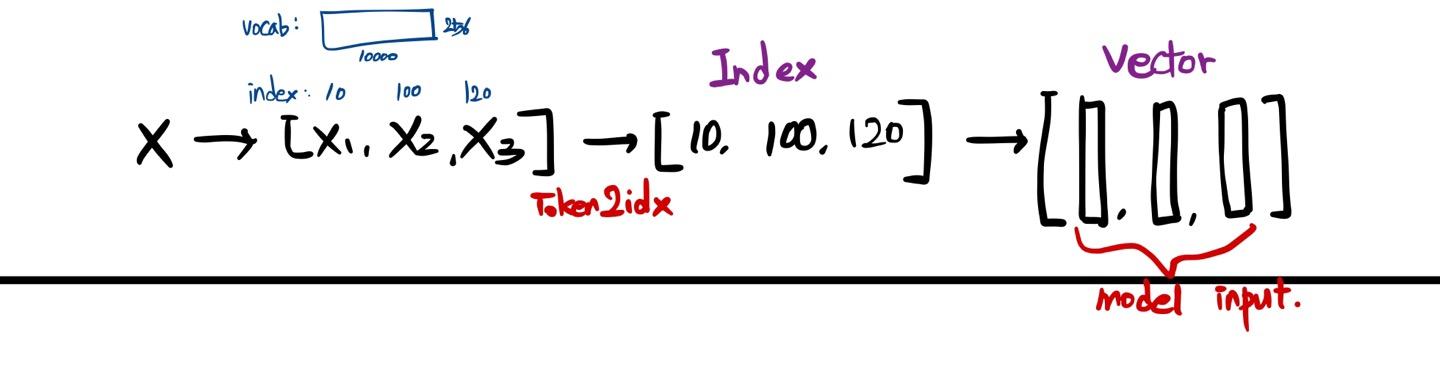
NLP Pipeline
- Data Collection
e.g., 문서 분류 API:
Sentence - 문어체, 구어체 dataset class
(문어체 - 신문기사 - 문어체 class - 0 / 구어체 - 블로그 글 - 구어체 class - 1)
[sent1, 1] x N(문장 개수) x M(블로그 개수)
# sent1 - list of tokens
- Preprocessing
- Pre-tokenization: cleaning, Normalization ···
- Tokenization
- Modeling
- 학습 train 코드
- 테스트 inference 코드
- Training
- Training Monitoring

- Evaluation
Metrics
- 정량평가: Accuracy, F1 score ···
- 정성평가 (by 사람): Userstudy ···
- Deployment
Server 효율성↑, 시간 단축 ···
- Performance Monitoring
Tokenization
Tokenization
- Model input
- Piece of text를 Token이라는 smaller units으로 separte
- Model은 seqeunce를 token에 의하여 recognize
| Tokenization | Tokenized Sequence |
| Raw Text | 나랑 쇼핑하자. |
| CV | ㄴ/ㅏ/ㄹ/ㅇ/*/ㅅ/ㅛ/ㅍ/ㅣ/ㅇ/ㅎ/ㅏ/ㅈ/ㅏ/. |
| Syllable | 나/랑/*/쇼/핑/하/자/. (음절 단위 token) |
| Subword | _나랑/_쇼/핑/하/자/. |
| Word | 나랑/쇼핑하자/. |
Tokenizer
- Word based Tokenizer
- Character based Tokenizer: 음절, 초성 + 중성 + 종성
- Subword based Tokenizer
| Tokenization | Tokenized Seqeunce |
| Raw Text (Input) | ['The devil is in the details'] |
| Word-based Tokenizer Output | ['The', 'devil', 'is', 'in', 'the', 'details'] |
| Character-based Tokenizer Output | ['T', 'h', 'e', 'd', 'e', 'v', 'i', 'l', 'i', 's', 'i', 'n', 't', 'h', 'e', 'd', 'e', 't', 'a', 'i', 'l', 's'] |
| Subword-based Tokenizer Output | ['The', 'de', 'vil', 'is', 'in', 'the', 'de', 'tail', 's'] |
Why use Subword-based Tokenizer?
- Word-based Tokenizer problem
Out-Of-Vocabulary problem
Train dataset 40 TB, Emb_size = 256 → 40TB x 256 = 10.24 PB .. ≠ 세상 모분포 dataset → Out-of-Memory
신조어 problem
Out-Of-Vocabulary (OOV)
- Character-based Tokenizer problem
Longseqeunce(['T', 'h', 'e', 'd', 'e', 'v', 'i', 'l', 'i', 's', 'i', 'n', 't', 'h', 'e', 'd', 'e', 't', 'a', 'i', 'l', 's'])
Low performance: Long sequence 처리 - Vanishing gradient, Memory problem ···
# if len_input_seqeunce > 200:
Performance ↓
∴ Use Subword-based Tokenizer
- Shorter sequence
- Higher performance
- (Almost) Free from OOV
e.g., 신조어 '알잘딱깔쎈'
Word-based Tokenizer → Unknown data로 처리
Subword-based Tokenizer → In vocab: 알(o)/잘(o)/딱(o)/깔(o)/센(x) → 정보 손실 ↓
Subword-based Algorithms
- Byte-pair Encoding (BPE)
Statistical method (e.g., GPT)
- WordPiece
- Pair set의 likelihood를 maximize하게 train (e.g., BERT, DistillBERT, ELECTRA)
E.g., p('ug') / p('u' then 'g')
- Unigram
- Pretokeinzedwords에서 시작하여 most common substrings then trims
- SentecePiece
E.g., ALBERT, XLNet, T5
Byte-pair Encoding (BPE)
- Statistical method (e.g., GPT)
E.g., aaabdaaabac
1. Z = aa
- pair aa가 가장 자주 등장하므로 이를 Z로 replace (단, Z는 기존 data에 없던 data여야 함!)
→ ZabdZabac
2. Y = ab
→ ZYdZYac
3. X = ZY
→ XdXac (X=ZY, Y=ab, Z=aa)
더 이상 가장 많이 나타나는 byte pair가 없을 때 까지 진행
- Performance ↑
- 보통, Vocab size가 50,000개가 될 때가지 진행
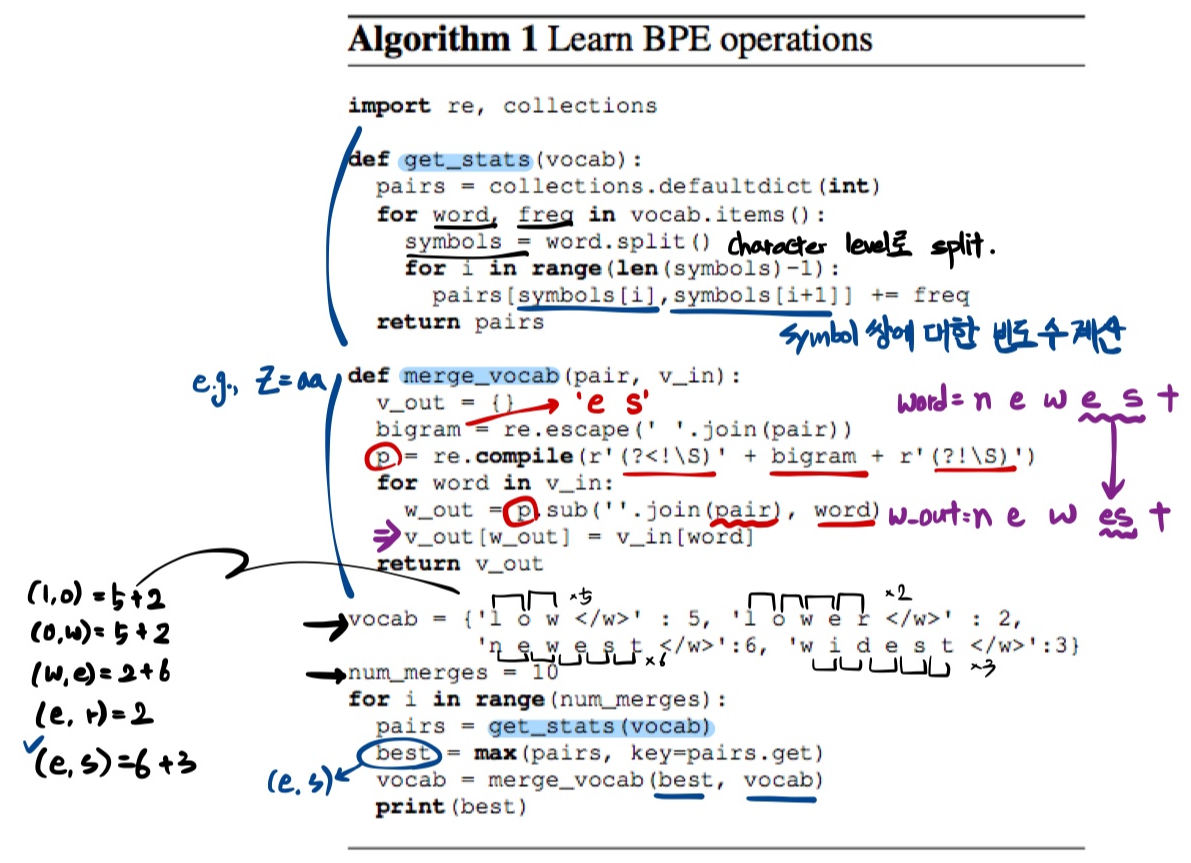
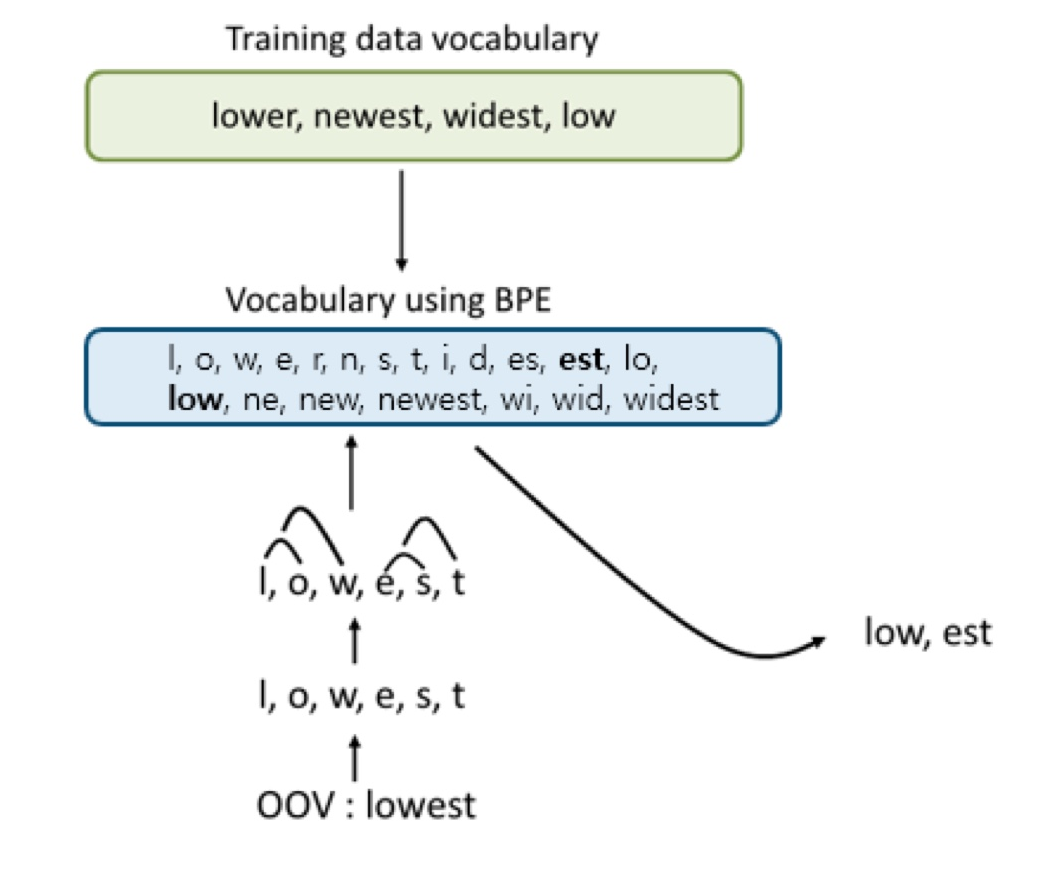
Image source: Byte-Pair Encoding: Subword-based tokenization | Towards Data Science
Data-centric AI ↔ Model-centric AI
질 좋은 data in NLP?
1) (X, Y)의 균일함
2) X_raw → X_input 변환 시, 정보 손실 최소화
→ Subword-based Tokenizer의 필요성
☞ 주어진 dataset에 맞춰 Tokenizer method를 변경해보는 것이 point
∴ Data preprocessing은 굉장히 중요하다!
'NLP' 카테고리의 다른 글
| Sinusoidal Positional Encoding 직접 계산해보기 (0) | 2022.07.01 |
|---|---|
| Transformer (0) | 2022.06.30 |
| Basic Regular expression 연습 (0) | 2022.06.27 |
| NLP preprocessing (0) | 2022.06.27 |
| RNNs with Attention (0) | 2022.06.24 |


